
Technical Tools For The Active Trader:
Techniques for Capturing Intraday Profits (page 4)
Whenever low volatility conditions have been identified, a break of a prior day high or low can often serve as the cue that the expected range expansion move has begun and can put us on watch for reduced-risk ways to participate. But even before such a break occurs, there are a few techniques that offer an advanced assessment of likely breakout direction and allow for earlier entry. For example, we can often determine directional clues from price action relative to the prior day high, prior day low, and the current Daily Pivot. If the market first approaches the prior day low, and is then repelled upwards through the Daily Pivot, breakout direction is likely to be towards higher prices (below left chart). Similarly, if the prior day high is approached, repelled, and price then moves through the Daily Pivot from above, likely breakout direction is to the downside (below right chart). Furthermore, often directional clues can also be found in market behavior near the Daily Pivot. If price activity is unable to breach this level, the expected breakout will often develop on a path opposite that of the original approach.
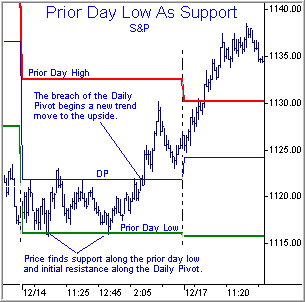 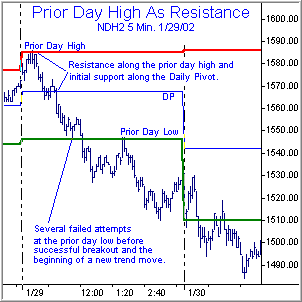 Charts created using TradeStation. ©TradeStation Technologies, Inc. All rights reserved.No investment or trading advice, recommendation or opinions is being given or intended. |
 Prior day highs and prior day lows represent extreme points of apparent value. As such, they contain the potential to act as support and resistance levels throughout the trading day. Price behavior near these levels can offer valuable clues as to the market's underlying intent.
Conclusion
Typically, most new traders approach the study of technical analysis with an eye towards identifying a single indicator, system, or trading methodology which, when practiced with precision and discipline, will reap rewards on each and every trade attempt (or at least very nearly so). Many traders, especially beginners, in their unending search for this one and only ultimate trading tool, tend to look at this discipline as having such potential . . . as containing the possibility of being the long sought-after magic key which unlocks the hidden secrets of future market direction. It is important that we not regard ANY technical trading tool in this light. Instead, they are better regarded merely as an aid in summarizing and simplifying certain discretionary aspects of our trading routine. Technical analysis gives an indication of what has happened on a fairly consistent basis in the past, but it make no guarantees of the future.
The techniques discussed in this article will jumpstart your understanding and interpretation of price behavior and underlying market intent, but don't expect them to become your Holy Grail. It is very likely that it may take a great deal of practice before you can comfortably integrate them into your normal trading routine. Some will be more effective under certain market conditions than others. Plan on spending considerable time with each tool before you start to fully realize its benefits as well as its shortcomings. As with all effective trading tools and techniques, nuance and idiosyncrasy become more apparent with practice.
Bob Hunt, developer of the Pattern Trapper Cutting-Edge Indicators Library and creator of the Pattern Trapper On-Line Trading Course and the JumpStart One-On-One Mentoring Program, is a registered CTA with over two decades of trading experience. He can be reached by e-mail at This email address is being protected from spambots. You need JavaScript enabled to view it. or by telephone at 952-892-5550
 Previous Page