  Home Home
Sample Issue
Subscribe
  2 Week Trial 2 Week Trial
Trading Course
Indicator Packages
|
Learning to trade the commodity markets with consistent gains is a difficult undertaking. Most are originally lured to this endeavor by the promise of easy profits. But there is little that could be further from the truth. There are no consistently "easy" profits to be made here. Oh, yes! We've all heard the stories about the lucky few who have struck it rich overnight. And we've all read the magazine adds that offer "systems" for sale that appear to be as good as a money-printing machine. But when these stories and advertisements are reviewed with any degree of scrutiny, they just don't hold up to their original promise. |
The Pattern Trapper takes an entirely different approach. Rather than offering fantastic promises of easy profits, it offers a way of approaching the markets that make their behavior more easily understood. The path to learning successful trading techniques starts with an understanding of price behavior. To learn how to understand price behavior you first need to learn how to create structure out of an inherently unstructured environment. The whole focus of this service is to help subscribers learn how to create that structure - to help them learn how to create "templates" for interpreting market behavior and spotting opportunity.The trading principles discussed throughout the report are applicable to any freely traded, liquid market. Each issue of The Pattern Trapper contains detailed analysis of the S&P;, Dow Jones, Nasdaq 100, and 30 year US Treasury Bond futures markets. This daily commentary serves as an example of how creating structure out of the markets can aid in their interpretation and understanding. The analysis is a day-by-day exploration of the way in which this can be accomplished, and the difference that it can make in one's trading. This Guide is composed of 15 sections:
Why T-Bonds?
When NOT To Trade
Cycle Indicators
Calculating Pivot System S&R Levels
Pattern Signals
Making Note Of Recent Intraday S&R
Reversal Patterns and Others of Interest
The 3/10 Oscillator
Entry and Exit Execution Techniques
Fib Retracements
Holy Grail Patterns
Practice! Practice! Practice!
The Psychology Of Trading
Putting It All Together
Why T-Bonds?
Each issue of the Pattern Trapper includes extensive commentary on the S&P;, Dow Jones, Nasdaq 100, and T-Bond futures markets. The analysis is equally appropriate for trading their e-mini contract versions (see "FAQ - Can I use the S&P; Analysis to trade the E-Mini?"). For the beginning trader, learning Pattern Trapper Trading Techniques via the T-Bond futures market has a number of distinct advantages.
For one, T-Bond market behavior typically has a very "plodding" nature about it. Provided that the trader avoids certain critical times (discussed in the "When NOT to Trade" section), T-Bond price activity is usually absent of the kind of volatility spikes so often associated with many other futures markets. This lends itself to a much more sane market atmosphere in which the trader has sufficient time to make well planned decisions.
Secondly, armed with the tools detailed in this guide, Bond market activity can have a surprising degree of predictability to it. By looking at price behavior through the "templates" described here, the trader is able to focus on high probability set ups, and avoid those trading periods with less predictability. Hence, the risk to reward ratio on every trade becomes much more favorable.
And lastly, the T-Bond futures market has excellent liquidity. This means that, under normal market conditions, the time in which it takes your broker to fill your order is usually very fast. Even more importantly, it also means that slippage, the degree in which price will move from the time you place your order to the time in which it is filled, is minimal - typically only one or two ticks. In addition, due to this market's large trading volume, it is much less prone to the kind of manipulation so often associated with more thinly traded markets. When NOT To Trade
There are certain times, most often when economic reports are released, that you just don't want to be holding short-term positions in financial instruments. The potential for extreme volatility is just too high. It is during these times that its best to just sit back and let the market tell you which direction it wants to take. You can usually get your bearings by waiting for 5-10 minutes after a report has been released before participating. Market entry can then be made with a greater degree of confidence, and you've reduced the chance of being whipsawed.
There are number of internet sources available to obtain calendars of important release dates and times (detailed in the full version of the guide). As release schedules often change, it is important to update this calendar once a week. Each trading day should begin with a reference to this calendar and a notation of the times in which important economic reports are scheduled for release.
Each issue of The Pattern Trapper lists the important economic releases for the trading day and a plan of action for dealing with each. Cycle Indicators
The Pattern Trapper regularly employs two Cycle Indicators as an aid in determining short term cyclical positioning. These indicators serve to identify those market periods in which short term tops and bottoms are likely to develop. Their interpretation helps determine any directional bias that might be assumed for a particular day of trading. These indicators are the Double Stochastic (or Double Stoch) and the 7 period %K.
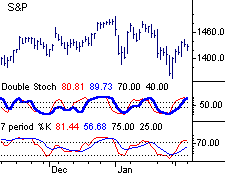
Chart created by Tradestation. |
The Double Stoch is a modification of Walter Bressert's own Double Stochastic Oscillator. Referring to the chart, both the 5 period Double Stoch (thin red line) and the 10 period Double Stoch (thick blue line) are used. The 10 period Double Stoch gives us an idea of where we are in the larger 20 period cycle. Typically, there are two smaller cycles within the larger 20 period cycle. The 5 period Double Stoch gives us an idea of where we are in those sub-cycles.
If you're interested in a further discussion of these concepts, visit Walter's site, he has much to offer there. If, on the other hand, all of this just seems very confusing, and you're really not that interested anyway, don't worry about it. For purposes of the daily report, Double Stoch oscillator readings are one of the components that go into determining any directional "bias" discussed for that day's trading. That's all you really need to know.
The 7 period %K is displayed directly beneath the Double Stoch. Once this indicator turns from an overbought or oversold zone, it is a fairly good indication that a new trend has begun and at least several more bars of the new short term direction should follow. But, as is true for ALL oscillator interpretation, when a larger overall trend is dominant, the overbought and oversold zones can mean very little.
Every issue of The Pattern Trapper includes Cycle Indicator charts for each Highest Potential Setup, as well as for the T-Bond futures market. Accompanying commentary contains an interpretation and discussion of each market's cyclical positioning and what it means in terms of directional bias as we enter each trading day. Calculating Pivot System S&R Levels
Floor traders and other professionals who do the actual buying and selling of futures contracts in the trading pits of the exchanges, generally employ very similar systems for valuing the price of such contracts in the absence of significant outside influences. These systems employ a method of calculating relative value based on price activity of the prior day. An equilibrium point is determined as well as support and resistance levels relative to that equilibrium point. This method is called the Pivot System. The seven support and resistance levels identified by this system are called, from top to bottom, R3, R2, R1, DP (for Daily Pivot), S1, S2, and S3.
These levels act as potential support and resistance zones throughout the day. They serve as focal points for floor professionals as they adjust their bids and offers, especially when trading activity is slow. The use of these levels, along with additional support and resistance levels as explained later, help in determining appropriate areas in which to initiate entry and place stops.
The full user's guide, issued to all subscribers, contains a complete discussion of the construction, and use of these support and resistance levels. Pivot levels for all of the futures markets covered by The Pattern Trapper are included in each report. Details for the construction of Pivot System levels, as well as for several other indicators, for use in various charting platforms are available to paid subscribers. Pattern Signals
Before we enter each trading day, it is important to first identify those markets which have either (1) the greatest potential for a significant move or (2) the greatest likelihood of following a specific price development. We accomplish this task through an automated pattern recognition process which identifies, for each futures market covered, today's most likely scenario based on recent price behavior. The process screens each market for a variety of setups of the type first identified by technical analysis books such as "Day Trading With Short Term Price Patterns And Opening Range Breakout" by Toby Crabel and "Street Smarts" by Larry Connors and Linda Raschke. The process screens each market for patterns such as Narrow Range Days, Wide Range Upside & Downside Reversals, 2 Day ROC Buys & Sells, Momentum PinBall Setups, Inside Days, Low Volatility Days, as well as a variety of other patterns, many of which are unique to the Pattern Trapper.
This process identifies those markets which have the greatest potential to create a profitable move either during the next day's trading session (intraday trades) or the next several trading sessions (multi-day swing trades). Each Pattern Signal fired for each market tells us something about the current price characteristics of that market and suggests a game plan to be used in the attempt to capture that profit.
Pattern Trapper subscribers have access to an extensive network of web-based interactive learning tools providing detailed discussions of each Pattern Signal fired, the conditions in place that triggered them, and trading techniques to best take advantage of the market information that they offer. Making Note Of Recent Intraday Support & Resistance
Prior to the beginning of each trading day, it is a good idea to take a look at the prior few days of trading with an eye towards spotting intraday highs and lows that are within a reasonable range of current price. These often act as support and resistance levels, especially when they form clusters. When a number of them are grouped within the same general area, it is a strong indication that the zone might be one of significance. In addition, any groupings near Pivot System S&R; levels serve to make that zone even more credible.
Reversal Patterns and Others Of Interest
Reversal patterns are most often single and double bar patterns that identify a likely turning point in market behavior. We use reversal patterns primarily on an intraday timeframe, most often on five minute bar charts. They will, however, work in just about any timeframe, and can often be effectively applied on one minute charts during fast market conditions.
Reversal patterns are oftentimes the trigger points used to enter and exit a trade. Being able to spot these patterns and knowing how to use them as they occur near important support and resistance levels is of critical importance in this method of day trading. They are the market's way of telling you "NOW!"
Some of the intraday price reversal patterns that the trader needs to be able to quickly identify are the U-Turn, J-Hook, and Doji (see the chart below for examples). The Pattern Trapper method of day trading uses the occurrence of these reversal patterns near support and resistance levels as a trigger into our trades. As explained earlier, Pivot System S&R; levels (as well as the more "dynamic" S&R; levels created by 20EMAs, which will be discussed shortly) represent chart areas which have the potential for creating significant shifts in market psychology. But, not every level creates a significant market reaction. The occurrence of price reversal patterns helps us distinguish those levels which have a greater likelihood of creating a reaction from those that don't.
Pivot System S&R; Chart with Reversal Patterns
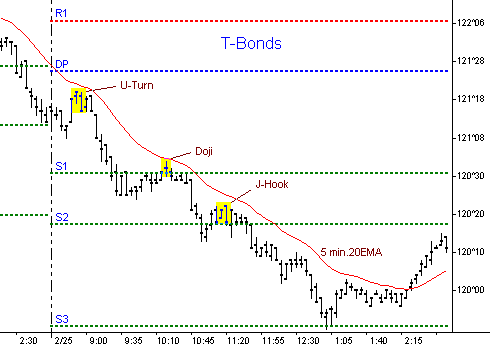
Chart created by Tradestation.
In addition to being able to identify very short-term one and two bar reversal patterns, the trader should also be able to identify a few intraday chart formations that might take a bit longer to evolve. Patterns such as triangles, wedges, flags, and channels develop on intraday charts in essentially the same manner as they do on daily, weekly, and monthly charts. Oftentimes, a break of these formations can be used as either a trigger into a trade or as an aid in determining directional bias.
For example, oftentimes an intraday news-inspired spike move will enter a short period of congestion as the market decides whether to accept or reject newly acquired price levels. That period of congestion often results in the creation of small flags or triangles on intraday charts. The flag pattern created shortly after a spike move higher is typically referred to as a bull flag, and the pattern created after a thrust in the opposite direction is often referred to as a bear flag. Many times, buying the topside break of a bull flag is a good way of climbing on board a market that wants to go higher, and selling the downside break of a bear flag is a good way to participate in a market that is going lower. Another productive intraday pattern is the wedge formation. Flat topped wedges typically imply a topside breakout. Flat-bottomed wedges suggest a breakout to the downside. Intraday Chart Formations
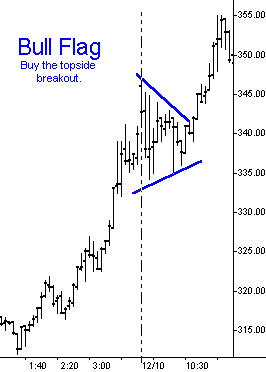 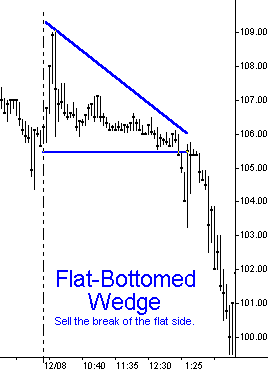
Charts created by Tradestation.The complete version of The Guide to The Pattern Trapper, issued to all subscribers, contains a full description of each Reversal Pattern along with diagrams. Also included in the welcome package are two sheets of pattern descriptions and diagrams that can be attached alongside your quote screen to help in their identification. In addition, as an instructional aid, the T-Bond Commentary in every issue of The Pattern Trapper identifies the set-up patterns that come into play on each trading day. The 3/10 Oscillator
Another very important way of identifying market turning points is by comparing the degree of price momentum behind successive market swings. Price momentum is a measure of the rate or speed of price change. Normally, if we are to expect successive market swings to continue creating new highs or new lows, we would expect the rate of price change to increase along with the new highs or new lows. If successive swings did not have an increase in momentum, the validity of the new push higher or lower would be called into question.
For the trading techniques advocated here, the 3/10 Oscillator is used as our principal measure of price momentum. We look to identify two principal conditions when using this indicator to help interpret market activity. These two conditions are called "Oscillator Divergence" and "Momentum Confirmation". Typically, each successively greater swing pivot high or swing pivot low will be accompanied by either one or the other.
In a market moving downwards, Oscillator Divergence is described as a new low in price which is accompanied by a higher low in the oscillator. In a market moving upwards, it is described as a new high in price which is accompanied by a lower high in the oscillator. Examples of both are shown in the chart below.
3/10 Oscillator Divergence and Momentum Confirmation
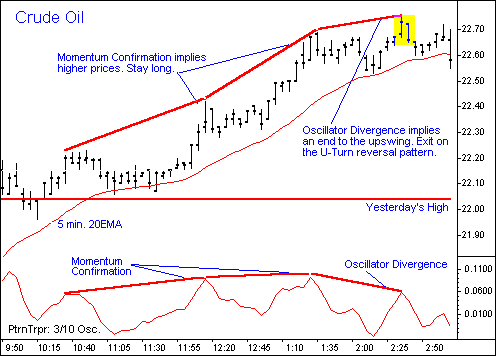
Chart created by Tradestation.In essence, when Oscillator Divergence occurs, the market is telling us that the current price movement is losing momentum. It is at these times that a reversal is most likely. If we had been considering a trade, this would be an opportune time to initiate entry.
On the other hand, when Momentum Confirmation occurs, we know that the current swing direction has some "oomph" left to it, and it would be best to either stay with any currently held positions or look for an opportunity to climb on board.
Whenever possible, we try to initiate market entry with an occurrence of one of the single or double-bar reversal patterns as described in the previous section. Sometimes, however, the formation of these patterns are a little more vague than we would like, and we are left wondering whether that particular U-Turn reversal was truly thrusting in both directions, or perhaps the J-hook just doesn't seem to hook as much as we would like. At times such as these, it is often helpful to refer to 3/10 Oscillator behavior to help make the decision as to whether or not to initiate trade entries and exits.
The 3/10 Oscillator is an invaluable tool when daytrading. It is a very good measure of market momentum and reveals much information about the market's true intent. Become proficient in its use, but also realize that it is not infallible. The more you use it, the more familiar you will become with its idiosyncrasies.
Entry and Exit Execution Techniques
By the time that we've identified a reversal pattern and/or oscillator divergence sufficient to trigger us into the market, we've already undergone quite a bit of analysis that puts the odds in our favor. Therefore, we want the trade to start working for us right away. If it doesn't, our analysis has failed somewhere along the line, and we want OUT! We don't allow ourselves the luxury of hesitation. We just want out! One of the keys to long term trading survival is the ability to quickly admit our mistakes.
Once we've identified a good reason to enter a trade (most often on a reversal pattern and/or Oscillator Divergence), the first thing that we want to do before actually initiating the trade is to consider stop placement. We want to identify a price level which, if obtained, would represent a decisive market movement against our position. Most often, for day trading purposes, this level is best defined by a violation of the swing pivot extreme which includes the reversal pattern and/or Oscillator Divergence used to make the initial entry decision. Stops are typically placed just beyond that level. If there happens to be an important support or resistance line nearby (one that price has not yet breached) we might want place the stop on the far side of that level so as to give the trade a bit more room to work. Examples are shown below.
Entry, Stop, and Exit Techniques
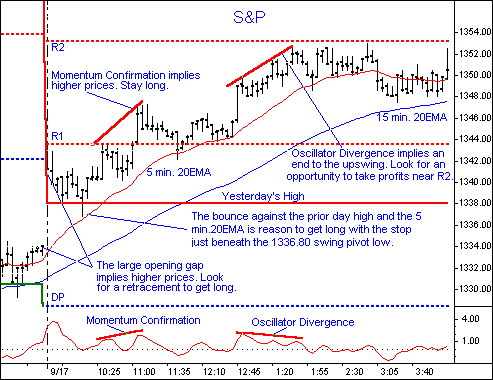
Chart created by Tradestation.Once the stop level is determined, we then need to make a quick decision as to whether the range between the stop level and our likely entry point is within reasonable levels of risk tolerance and in line with profit expectations (risk/reward ratio). These considerations are largely dependent on such aspects as the individual characteristics of the market being traded, the type of order used to initiate entry (market, limit, etc.), and our means of determining likely profit targets. If these factors fall into place, we can then initiate entry with confidence.
Another important note concerning the use of stops is that we don't always HAVE to stick around until our stop level gets hit. The stop order is there only for protection - protection against both quick market movements and ourselves. The best trades take off in our favor right away. But it doesn't always happen that way, and if the market starts getting sloppy, or a reasonable period of time has passed and price hasn't started moving in our direction, we need to decide whether its worth sticking around or not. The old adage "When in doubt, get out!" certainly applies here.
The rules for entering and stop placement are rather clear cut. But the appropriate procedure for exiting with a profit can oftentimes be more demanding. We use the same parameters for measuring market movement in exiting with a profit as we do in entry and stop placement. The only difference is that there is a little more latitude here - a little more of the "art" of trading.
We look for the same primary conditions to set-up when making exit decisions: price reversal patterns and/or Oscillator Divergence. It's just that this time, we try to take in the larger picture a bit more. We take into consideration such things as the "feel" for the strength of the larger trend, cyclical positioning, and pattern set-ups such as triangles, wedges, channels, or flags. If our "feel" of the market is that the trend has quite a bit more left in it, we might place less emphasis on other factors and just go along for the ride, gradually moving the stop closer as price moves, so as to lock in at least some portion of our accrued profits. This is something for which one needs to develop a feel - and that takes time and experience.
One tool that comes in very handy when making exit decisions is Fib retracements. Fib Retracements
Simply put, Fib Retracements are used on an intra-day basis to measure how far a market has retraced its primary move. It helps determine, in large part, how much the market has taken back, from that which it has already given. If the market "takes back" only a small portion (.382) before continuing in the primary direction, we know that the trend is strong and that it will likely continue past the most recent intraday swing pivot. If the market "takes back" a slightly larger piece (.5), then we know that continuation of the previous trend is less likely. And if it "takes back" a significant chunk (.618), we know that the trend is much more poorly established than original impressions might have left.
For instance, if we refer to the chart below, we see an initial primary move in Microsoft quickly take price from the 94 3/4 early morning swing pivot low, to the 97 3/16 swing pivot high. A short while later, price has drifted back down towards the .382 Fib retracement line. Initially, it appears as if this level might hold, and, indeed, price is eventually able to work its way back up towards the high of the day. But this zone is soon rejected and the market begins a descent which eventually spikes through the .382 Fib retracement level. This kind of action tells us that the push behind the original move higher is not as strong as initial impressions might have left. The .500 Fib level is able to contain the action for a short while, but once the .618 level falls, the flood gates open and the market begins a drop that continues on into the next day of trading.
Fib Retracements
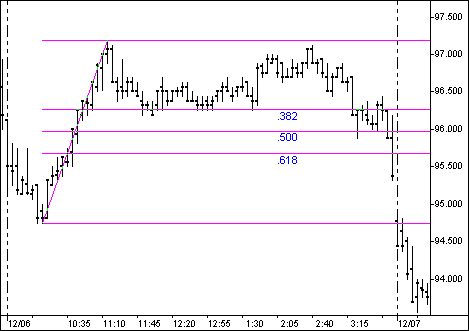
Chart created by Tradestation.The use of Fibonacci retracement can be a very valuable aid. It is definitely worth adding to your arsenal of trading tools. A full discussion, with additional examples, is included in the complete Guide to Using The Pattern Trapper, available to all paid subscribers. Holy Grail Patterns
Holy Grail setups were originally introduced in the "Street Smarts" book by Linda Raschke and Larry Connors. The method uses ADX to determine a trend, and an exponential moving average to decide the appropriate time within a pullback from that trend in which to enter.
Five different time timeframes are monitored for Holy Grail setups: 5, 15, 30, 60, and 120. If the trend in any one of those time periods is strong enough to register an ADX reading greater than 30, we want to watch for any retracement to the 20 period Exponential Moving Average in that timeframe. Consider the 20EMA as a "dynamic" support or resistance line - one which moves with the market. Treat it as you would any other static support or resistance line. Any price reversal pattern that develops along that line is cause to consider entering the trade.
Holy Grail Setups
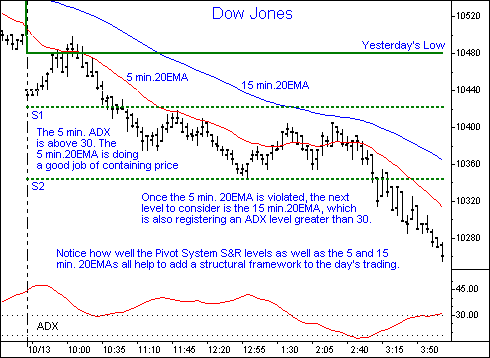
Chart created by Tradestation.You will often find opportune use of the 5 minute Holy Grail pattern after a strong initial impulse move, especially those caused by the release of significant economic reports or other news driven price thrusts. Oftentimes, the first retracement level will be that of the 5 minute 20EMA. Keep a close eye on retracements to this moving average line when the market seems to "take off".
The intent of the Holy Grail setup is to catch the first retracement on an initial trend move. Trend moves imply that there is more to come. Therefore, when basing a trade in part on Holy Grail patterns, you can typically set your minimum profit target to be that of the last swing pivot extreme in your direction. But, many times that trend move has much further to go. So give the trade room to breathe. Here again, single and two bar reversal patterns and/or Oscillator Divergence/Momentum Confirmation are good tools to use when deciding whether or not to exit near the level of the last swing pivot extreme. Keep in mind, however, that if the move is particularly strong, a trend force of a larger timeframe can be in effect which can easily overshadow oscillator behavior on the smaller timeframes. Again, experience is the best teacher. Start off trading small until these techniques have become more fully integrated with your daily routine. Only then will you start to appreciate many of the idiosyncrasies that only familiarity can reveal.
A full discussion of entry and exit techniques based on Holy Grail patterns is included in the complete Guide to Using The Pattern Trapper, which is available to all paid subscribers. Practice! Practice! Practice!
In order to make the most effective use of the techniques described in this guide and throughout the daily report, it is important that you develop a feel for them on a very visceral or "gut" level. It is best that they become an automatic reaction . . . instinctively integrated with the way in which you approach the market. The goal is to get to the level where you can look at a chart and be able to instantly zero in on the pockets of opportunity.
The complete Guide to Using The Pattern Trapper includes specific methods for practicing the techniques discussed here. With a thorough understanding and repetitive practice, the goal is to attain enough confidence to take advantage of these profit opportunities on a consistent basis.
The Psychology Of Trading
The psychological aspects of trading are of paramount importance. This guide has given you some of the basics for understanding the technical aspects, but of equal or even greater importance is an understanding of how your mind works, especially in regards to the way in which you handle fear and greed.
You will find reference to the psychological aspects of trading peppered throughout the commentary. Maintaining the proper attitude throughout the trading day can mean the difference between failure . . . and long term success. Putting It All Together
Although this condensed guide is offered as an overview of the service, the complete Guide to Using The Pattern Trapper is designed so that it may stand on its own as a day trading technique. The daily reports can be considered as a constant re-enforcement and consistent reminder of the concepts covered in the complete guide, as well as a helping hand and note of encouragement as you enter each trading day.
The intent is to give the subscriber a framework for evaluating market conditions and the best way to exploit them. The path to understanding successful trading techniques starts with an understanding of price behavior. You cannot understand price behavior until you learn to create structure out of an inherently unstructured environment. The whole point of The Pattern Trapper is to help the subscriber create that structure - to help them create "templates" for interpreting market behavior and spotting opportunity.
It is my hope that the practitioner of these techniques will save a great deal effort and money lost, by not having to go down a GREAT many dead-ends before becoming successful. But it is still going to take a great deal of practice, unflinching execution, and some deep levels of personal soul-searching.
The Pattern Trapper offers an experienced trader as a partner on that journey.

|
