Understanding The Odds:
Trading The Opening Gap in the Mini Index Futures Contract
By Bob Hunt, developer of the Pattern Trapper Cutting-Edge Indicators Library and creator of the Pattern Trapper On-Line Trading Course and the JumpStart One-On-One Mentoring Program, is a registered CTA with over two decades of trading experience. He can be reached by e-mail at This e-mail address is being protected from spambots. You need JavaScript enabled to view it or by telephone at 952-892-5550 |
This article describes just one of the many high probability trading setups included as part of the JumpStart One-On-One Mentoring Program, a powerful new series of indicators and a dynamic mentoring program designed as a jump-start to successful day-trading in the Index Mini Futures contracts. Click Here! for more information on this exciting new program.
To view the 8 minute video presentation on the Open Gap Trading Technique recently made at the Dallas chapter meeting of AFTA, click on the link below. Be patient - the file may take 5-10 minutes to fully download. For multiple viewings save the file to your hard drive, then double click to start. Click Here!
. . . . . . . .
Many active traders regard the futures markets as unsuitable largely due to an assumption that the endeavor requires massive amounts of time and energy. It is true that effective full-time trading DOES require a serious commitment. But an initial introduction does NOT require the participant be "chained" to a computer screen all day. Effective trading can, and for many successful traders, does consist of employing only one or two very high probability setups that regularly occur during specific time periods of the day. These are traders who have done their research, they fully understand the odds behind their methodology, and they execute their trades in a very disciplined fashion. The purpose of this article is to explore just one high probability setup that normally occurs within one specific time period of the trading day - that of the opening gap.
An opening gap occurs when the market begins the trading day at a price other than where it closed at the end of the previous session, resulting in a "gap" in price when viewed on an intraday chart. If this discrepancy is unusually large, it is likely that new information has entered the marketplace, and price activity will tend to trend even further in the gap direction. If the difference between closing and opening price levels falls within a more reasonable range, there will be a tendency for the market to trade back into the gap area. The strength of this tendency is indirectly proportional to the magnitude of the gap. The narrower the gap, the stronger the tendency. Very small gaps are not even tradable. Very large gaps are less likely to close, and contain the potential to quickly move even further away from the gap level, marking the beginning of a strong trend move. These kinds of gaps are referred to as "Breakaway". On the other hand, the kind of gaps that have a higher probability of closure, and the sort that we are most interested in for the purposes of this article, are referred to as "Common" gaps.
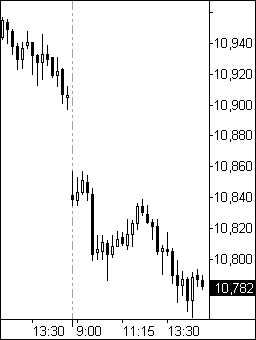 Breakaway Gap |  | 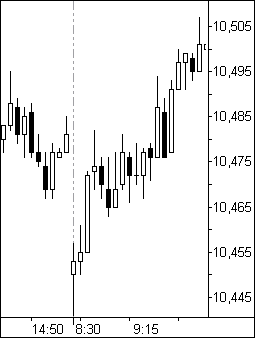 Common Gap |
| Charts created by Tradestation | ||
There are no hard-and-fast rules that determine one gap a Breakaway and another Common, but a few general guidelines can be used to help differentiate between the two. The fist is time-based. If the opening price on a gap to the upside stands as the low after the first 30 minutes of trading, the gap will most likely be of the Breakaway kind. And, on a downside gap, if the open remains the highest price traded within the first 30 minutes, there is a high likelihood that the gap is of a Breakaway nature. Another consideration is the magnitude of the gap. An opening gap level that falls below the levels noted below can generally be regarded as Common. Gap levels that are greater than the ones noted below can be thought of as Breakaway. If a gap level falls between the two we can think of it as having an equal chance to develop as either Common or Breakaway. Remember that these levels are to be used only as a very rough rule-of-thumb. They are relevant at the time of publication, but may vary to some degree with changing market conditions.
| Gap Size Guidelines | ||||
| Market | | Common | | Breakaway |
| S&P 500 E-Mini (ES) | < 4.00 points | > 7.00 points | ||
| Dow Jones Mini (YM) | < 40 points | > 70 points | ||
| Nasdaq 100 E-Mini (NQ) | < 10.00 points | > 18.00 points | ||
| Russell 2000 E-Mini(ER) | < 2.00 points | > 3.50 points | ||
A third method used to differentiate between the two is based on NYSE Tick readings. The Tick is provided by most intraday day data providers and represents, at any given moment, the number of stocks trading higher on the NYSE minus the number of stocks trading lower. A positive reading is bullish, as it represents a greater number of issues increasing in price, whereas a negative reading is bearish. An opening gap to the upside that cannot exceed a NYSE tick reading of +300 within the fist few minutes of trading is generally considered to be of a Common nature. On the other hand, an upside gap that occurs on a tick reading greater than +300 and climbs as price climbs can usually be regarded as Breakaway. Alternately, a downside gap that does not drop below -300 within the fist few minutes can be considered Common, while one that occurs on a tick reading below -300 and drops as price drops can be considered Breakaway. Again, it is emphasized that these parameters are best regarded only as a rough rule-of-thumb, and should not be used in mechanical fashion. Think of them simply as extra bits of information that assist in interpreting internal market dynamics.
In addition to the guidelines mentioned above, there are a few other market variables that we want to take into account before the start of the trading day. These considerations aid in determining the likely nature of trading activity in the early hours, and helps us to decide whether the opening gap (if one exists) is likely to be tradable. First off is a review of Trin (sometimes called the Arms Index in honor of its developer, Richard Arms). This is a breadth oscillator designed to measure internal market strength, and is most often provided as part of a real-time datafeed. Although a modified version of Trin is preferred in that it delivers more detailed information and is far easier to read (which is especially important during fast-paced, hectic trading conditions), the levels noted here reflect the standard Trin, which will be more easily accessible for most readers. A closing prior day Trin reading near or above 2.0 tells us that the day ended on an excessively bearish tone. If overnight pricing has not already swung to the upside, we can usually expect it to do so in the very early part of the trading day. Once this excessive bearish pressure is released, further downside typically follows. On the other hand, if prior day Trin finished near or lower than .5, we know that the day ended with excessive bullishness. A push lower should occur either in overnight trading or early the next day. Once market tone is effectively neutralized further upside normally ensues.
Just before market open it is also a good idea to mark on our intraday chart the price high and low points that occurred in overnight trading (all trading activity that occurred since the prior day close). If market activity is thought of as an auction process, where bidders and sellers are constantly vying for the most advantageous price, overnight highs and lows represent the outer extremes of accepted value for that particular period of time. The highest price achieved represents the maximum that buyers were willing to offer, and the lowest price represents the minimum that sellers were willing to accept. For this reason, subsequent price action has a tendency to remain within the boundaries of apparent value as defined during this period. If these limits are exceeded to the upside, we know that current market activity has a bullish tone to it. On the other hand, any downside push that surpasses the overnight low has bearish implications.
As the market nears its opening bell, and actual gap size is better known, we then concentrate on a set of statistics that describe the odds of price returning to the prior day closing level. Using gap level historical price information, market-specific probability of closure can be calculated and displayed as a known value just prior to the beginning of each trading day (chart below). This information is dependant on the direction and size of the gap, and can tell us what the chances for full closure happen to be along with the odds of half-gap closure (which are always greater than full closure). We can also determine the probability of closure based on the current day of the week, as well as note any other significant variables that may effect the probability of gap closure (such as special precautions necessary on the day after Options Expiration Friday or on "first Friday" Employment Report Days).
With this information in hand, and assuming the gap size is tradable with a high probability of closure, we can then begin the day with an eye towards placing a trade in that direction. Some of the variables that are best monitored just prior to placing a gap trade are (1) price action relative to significant support and resistance levels (i.e., regular session highs and lows established on each of the prior two trading days), and (2) NYSE Tick readings as a sign of short term trend exhaustion. It is especially important to measure the market's current state of expansion/contraction. Is the market currently trading in an ever-tightening range, or has it instead just begun a strong move in a direction opposite gap closure? An indicator called the "Volatility Expansion Meter", referred to as "Vol-X" in the chart below, can tell us when, and in which direction, a big move is likely to begin. If Vol-X is firing a signal in the opposite direction as gap closure, we definitely do NOT want to place a trade in the direction of gap closure. Rather, we would want to be looking for a trade in the same direction as the gap. Although a detailed explanation of Vol-X is outside the scope of this article, the standard application of Bollinger Bands can provide a similar, although less precise, glimpse into these kinds of internal market dynamics.
As an example, please refer to the chart below, which depicts an opening gap trading opportunity in the Dow Jones Mini contract. The indicator in the top left screen reports gap size, direction, and accompanying statistics prior to and at the moment the market opens (all time references are basis the Central Time zone). This indicator tells us that the odds for closure are high, and that we want to look for an early opportunity to get long. The "Leading Market Sectors" chart directly below the gap statistics display tells us that the three sectors that often lead market activity are starting the day with a definite bullish bias, adding even more reason to be on the long side. In the large one-minute candlestick chart we can see that "Vol-X" has not fired a signal to the short side, which indicates that range expansion lower is unlikely. Perhaps the most significant factor affecting our decision to take this trade is that the NYSE Tick reading ($TICK) is unable to muster any momentum to the downside. In fact, it can't even break down through the zero level. The rise in Tick readings is our trigger into the trade, which gets us in a few points before the 10397 level of Today's Open is breached. A protective stop is placed just below the closest known support zone, which is that of S2 at 10384.

Charts created by Tradestation
The market moves in our favor in rapid fashion, finding only temporary resistance along S1 and YYL (the daily low two days prior to today's trading). The Half Gap Fill line is quickly surpassed as the market moves on to reach the Full Gap Fill target of 10428. The trade nets a total of 33 points, or $165 per contract less commission and fees. It is also worth pointing out that the market made a short term bounce away from this level once the gap was filled. This is a common occurrence. A stop and reverse placed at the gap fill level can often garner a few extra points of profit. Again, NYSE Tick readings can confirm the reversal point as well as serve as our exit trigger.
In summary, successful gap trading requires a series of considerations taken (1) before the market opens, (2) as the market opens, and (3) thirty minutes after market open if the gap has not yet closed:
| 1. Before the market opens: | ||
| Prior day closing Trin readings: A closing Trin near or above 2.0 typically results in an early swing to the upside. A Trin near or lower than .5 can mean a swing to the downside. | ||
| Mark overnight highs and lows that may act as potential support or resistance within the gap area. | ||
| 2. As the market opens: | ||
| Use the Gap Size Guidelines table depicted earlier to determine its Common or Breakaway status based on the magnitude of the gap. | ||
| Assess probability of closure based on gap level historical price information derived either from your own statistical research or from software designed to perform this task. | ||
| Pay attention to opening NYSE Tick readings. An upside gap on Tick readings less than +300 is likely to close, as is a downside gap on Tick readings greater than -300 (i.e, -100). | ||
| 3. Thirty minutes after the market opens: | ||
| If the open on an upside gap is the lowest price traded during the first 30 minutes, the gap is likely Breakaway, as would be a downside gap whose open is the high of the first 30 minutes. Look for opportunities to participate in the direction of the gap rather than against it. | ||
The successful trader, to paraphrase a song made popular by Kenny Rogers in the late seventies, "knows when to hold 'em, and knows when to fold 'em". For them, effective trading has developed into a constant process of creating action plans in direct response to consistently changing market conditions. They participate only if the market develops according to their plan. If not, they simply "fold 'em" and walk away with their eye on the next potential setup. The opening gap trade in the indices offers one such high potential action plan. Learn to trade it effectively and you'll be a significant step closer towards long-term consistent success.